

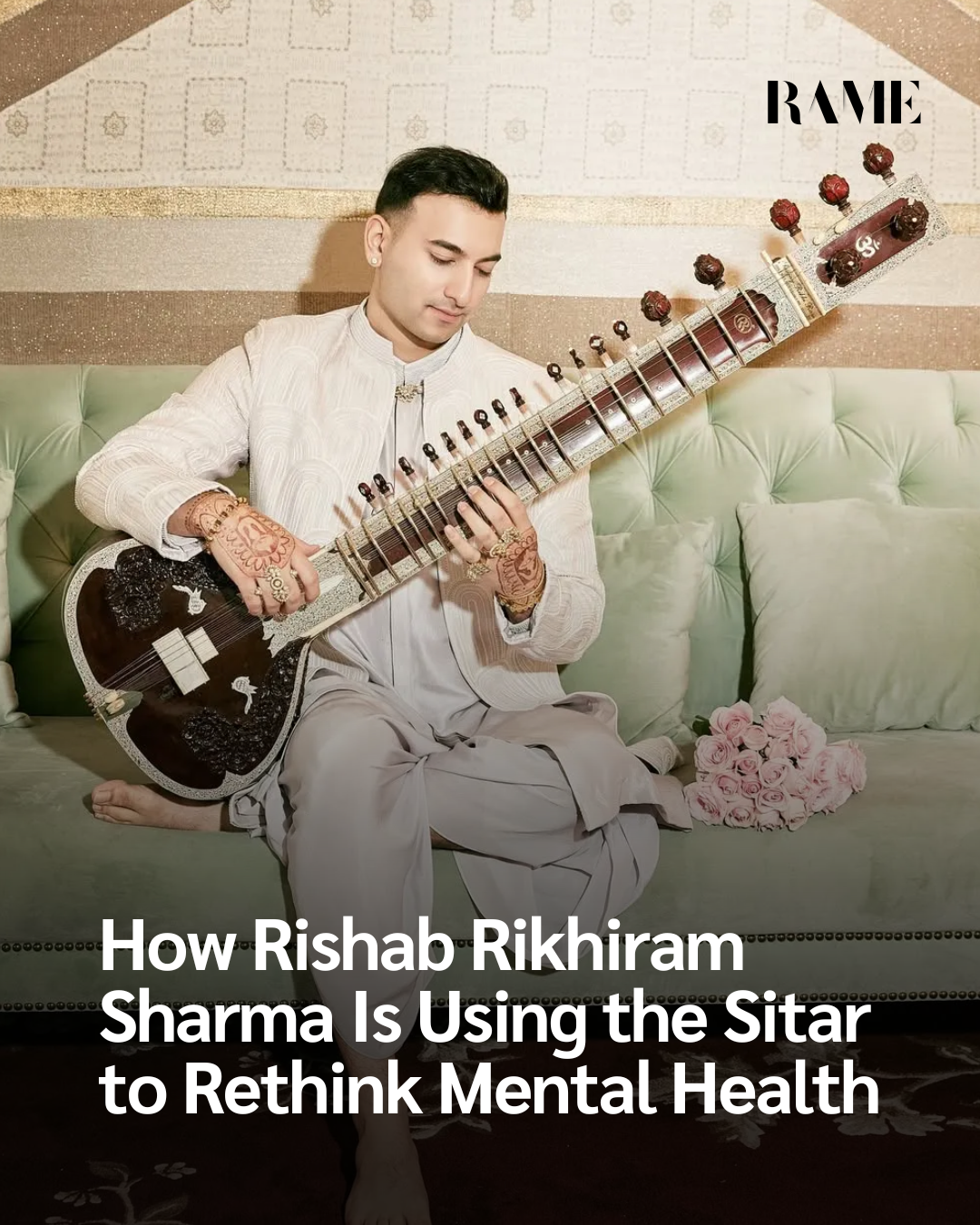
India’s classical music tradition stretches back centuries, but for sitarist Rishab Rikhiram Sharma, it has become something more than cultural heritage. It is a living, evolving tool for navigating anxiety, burnout, and emotional overload in the modern world.
Speaking at the ET Now Global Business Summit, Sharma didn’t just perform. He reflected, candidly, on how music helped him survive one of the most mentally challenging periods of his life: the Covid-19 pandemic.
“I think music was very instrumental, no pun intended,” Sharma said during the session. “But it was a combination of therapy, music and working out that really helped me get out of that phase that I was in during Covid. Music has been keeping my mental health in check.”
What followed was not a standard concert story, but a window into how classical music is being reimagined as a form of emotional care.
From Concert Hall to Collective Healing
Sharma’s performances today look very different from conventional classical recitals. His shows are structured more like guided experiences than concerts.
“At our shows, we start with a breathing exercise, then we lead into meditation,” he explained. “Then we do alaap, jod and jhala, which comes from Dhrupad music, a very ancient tradition in our culture.”
In practical terms, this means audiences are not just listening, they are participating. The first part of the show is slow, improvised, and introspective. Only later does the set transition into Bollywood themes, patriotic melodies, and original compositions.
“We’ve crafted this set to feel more like a community experience than just a performance,” Sharma said.
Audience responses suggest something deeper is happening. “We receive so many testimonies from people about emotional releases at the shows,” he added. “Whatever happens, happens in that moment.”
This idea of collective emotional processing through sound sits somewhere between concert, meditation circle, and informal therapy session, though Sharma is careful not to claim anything clinical.
The Power of Improvisation and Uncertainty
One of the most striking elements of Sharma’s approach is how little of his performance is fixed in advance.
“You’ll never see the first half of my show repeated twice,” he said. “It’s completely improvised.”
That unpredictability, he believes, is part of the psychological effect.
“I think it’s a two-way street. It’s a journey for both of us because I don’t know what I’m going to play.”
In a world dominated by algorithms, playlists, and predictable content, this kind of live uncertainty becomes rare. From a mental health perspective, it forces both performer and listener into the present moment, which is a core principle of mindfulness practices.
Psychologists often point out that anxiety is rooted in anticipation and rumination. Improvisation disrupts both.
The Science Behind the Sitar
Sharma is not just relying on intuition. He is also involved in ongoing research into how sitar music affects the body and brain.
“There is some research we are doing where we’re recording brainwaves and ECG reports,” he said. “We’re monitoring what happens when you listen to the sitar. It’s still a work in progress. It’ll be a couple of years before we get real data.”
This aligns with a growing body of international research on music therapy. Studies from institutions like Harvard Medical School and the American Psychological Association have already shown that slow, structured music can reduce cortisol levels, lower heart rate, and activate brain regions associated with emotional regulation.
What Sharma is attempting is to build an Indian classical parallel to that research, grounded in ragas and traditional forms rather than Western compositions.
If successful, it could give scientific backing to what many listeners already report anecdotally: that certain sounds genuinely shift mental states.
A Comeback Tour in an Overstimulated World
This year marks a turning point in Sharma’s touring career. After cancelling several shows in 2025 due to the India-Pakistan conflict, he is now returning with a scaled-up, 10-city pan-India tour.
“This feels like a comeback,” he said.
With Delhi and Mumbai already sold out, the tour continues to centre around breathing, meditation, and what Sharma calls “taking a pause”.
That language resonates with a wider cultural moment. Burnout, digital fatigue, and anxiety are now mainstream conversations, particularly among urban youth. India, according to the World Health Organization, is one of the countries with the highest burden of anxiety and depressive disorders globally.
Sharma’s concerts position themselves as an antidote, not through medication or motivation, but through controlled slowness.
Beyond Genres and the Gen Z Shift
Despite his growing association with devotional and meditative music, Sharma resists being boxed into a spiritual niche.
“Don’t get me wrong, I’m super hip-hop myself,” he said, citing Kanye West and Playboi Carti among his regular listens.
Yet he believes the surge in devotional music among young audiences reflects real lifestyle changes.
“Gen Zs are drinking less. They’re focusing more on health. I think this was a natural by-product.”
Data supports this. Multiple global surveys show Gen Z consumes less alcohol, is more open to therapy, and places higher value on mental well-being than previous generations. Spiritual or reflective music fits naturally into that shift, even when detached from formal religion.
“I’m Not a Therapist”
For all the attention around mental health, Sharma remains grounded about his role.
“I never claimed to be a therapist,” he said. “I can only speak from my experiences. Try it. If it works for you, it works. If it doesn’t, it doesn’t.”
This restraint matters. In an age where influencers often overstep into medical territory, Sharma’s framing keeps his work experiential rather than prescriptive.
As the evening closed with chants of “Om Namah Shivaya” and a live rendering of “Shiv Kailash”, the audience wasn’t left with spectacle or slogans.
They were left with silence, breath, and stillness.
And perhaps that is the most radical idea of all: that in a culture built on noise, productivity, and constant stimulation, the act of pausing itself has become a form of healing.