

Introduction: strong growth, uneasy signals beneath the surface
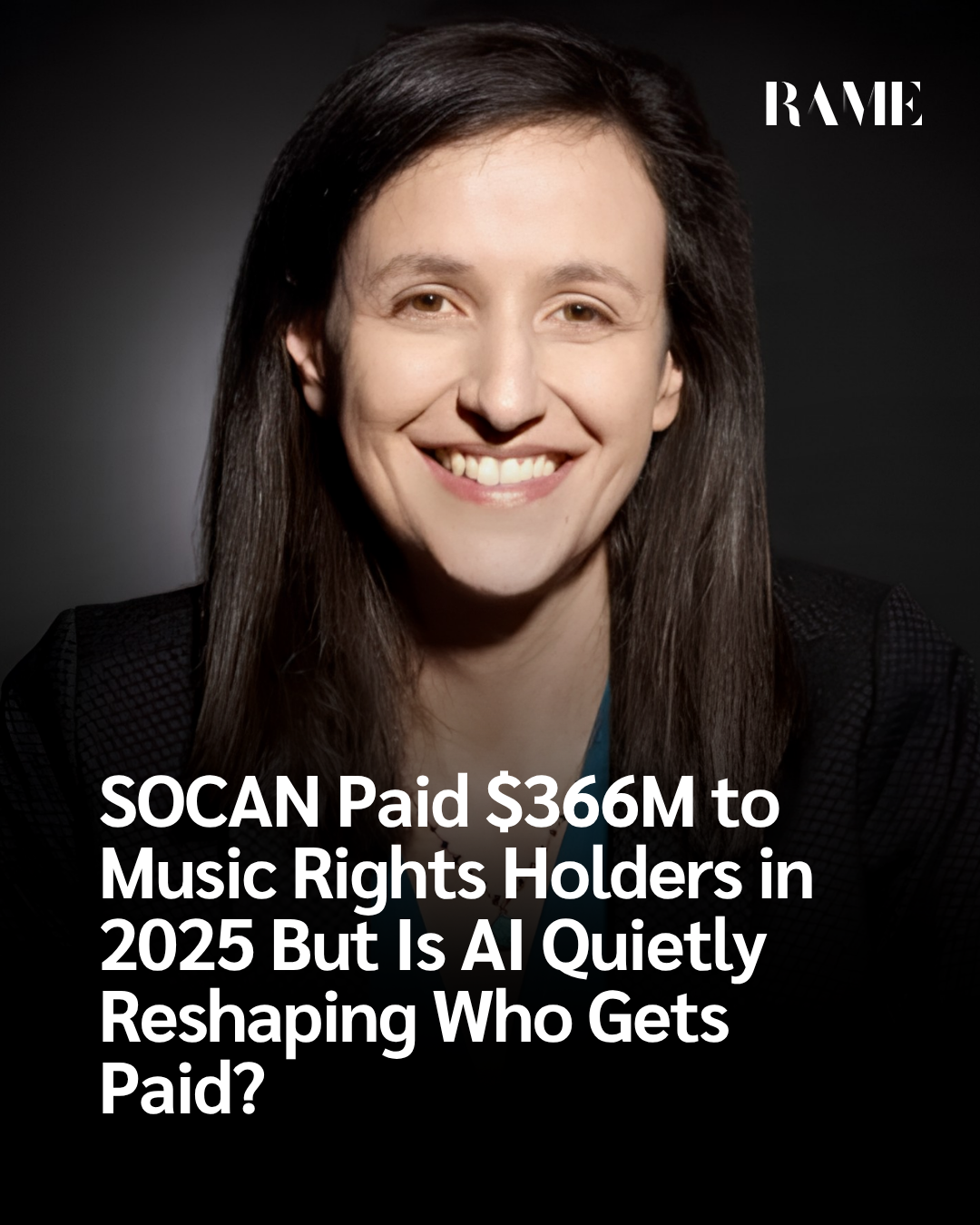
Canada’s music rights ecosystem posted another year of solid financial growth in 2025, with the country’s performing rights organization SOCAN distributing hundreds of millions in royalties to creators.
But beneath the headline numbers, a more complicated story is taking shape.
While streaming continues to drive revenue upward, SOCAN is warning that artificial intelligence is beginning to reshape the economics of music creation in ways that could undermine the very people these revenues are meant to support.
The tension is clear: record collections on one side, structural uncertainty on the other.
Revenue climbs to CAD 587M, driven by streaming growth
SOCAN reported total revenues of CAD 587.1 million (about $420 million), marking a 5% increase from 2024.
Digital streaming remained the primary growth engine, reinforcing how deeply music consumption has shifted toward online platforms.
Key breakdowns from the 2025 financial year:
- Revenue from music used in Canada: CAD 445.5 million
- Digital revenue share: CAD 232.8 million (up 11.5% year over year)
- International revenue: CAD 141.7 million
- General licensing and concert income: up 16.1%
The numbers show a familiar trend: streaming is still expanding, but other revenue streams like live performance licensing are also recovering and growing steadily.
$366M returned to creators but payouts remain nearly flat
SOCAN distributed CAD 511.9 million ($366 million) in royalties to members during 2025, slightly below the previous year’s CAD 512.4 million.
That near-flat movement is notable given rising revenues, suggesting increased costs or timing differences in distribution cycles.
The payouts were divided as follows:
- CAD 183.8 million: domestic music usage in Canada
- CAD 126 million: international performing rights
- CAD 11.8 million: reproduction rights
Even as the overall pie grows, the distribution pace signals a system under pressure to keep up with a rapidly changing music economy.
AI pressure becomes central concern for SOCAN leadership
The most politically charged part of SOCAN’s report is not financial it is technological.
The organization explicitly warned that AI is now a structural risk to creator livelihoods.
As SOCAN put it:
“AI is placing mounting pressure on music rights and the livelihoods of music creators.”
This is not framed as a distant concern. It is already shaping policy campaigns, lobbying efforts, and licensing debates across Canada.
SOCAN also highlighted a national survey conducted with Pollara, which found that 81% of Canadians believe supporting local music creators is essential to the future of Canadian culture.
That statistic is doing a lot of work rhetorically: it positions music rights not just as an industry issue, but as cultural infrastructure.
Lobbying Ottawa: consent, credit, and compensation
SOCAN says it has escalated its policy push with a national campaign generating 8,700 letters to government, urging policymakers to prevent any AI training exemptions that would allow unlicensed use of music.
At the center of this advocacy is a simple framework: consent, credit, and compensation.
SOCAN CEO Jennifer Brown argues the current system does not yet protect creators in the AI era:
“There is an urgent need for modern protections rooted in consent, credit and compensation, to provide songwriters and composers with a reliable foundation from which to support their families and continue making music.”
Brown also met with Canadian Prime Minister Mark Carney alongside CISAC leadership to raise concerns about AI and creative rights.
The meeting signals that this is no longer just a cultural debate, it is now a policy-level negotiation at the highest political tier.
Global alignment: ASCAP, BMI, and AI registration rules
In October 2025, SOCAN joined US counterparts ASCAP and BMI in aligning AI registration policies.
The key shift: they will now accept registrations for works partially generated using AI.
This is a subtle but important change. It does not settle the debate over AI’s role in music, but it acknowledges reality, AI is already inside the creative pipeline, and rights systems are being forced to adapt.
Leadership perspective: creativity in a hybrid future
Björn Ulvaeus, speaking alongside SOCAN leadership in discussions about AI and creativity, has been part of broader international advocacy through CISAC.
SOCAN President Jennifer Brown has emphasized a dual reality: financial growth today, but uncertainty about tomorrow.
That contradiction defines the moment. Revenue is up, but confidence in long-term creator protection is not.
Costs rise as SOCAN invests in infrastructure
SOCAN’s operating expenses also increased, pushing its expense-to-revenue ratio to 13.4% in 2025.
The organization attributes this to:
- enterprise technology investment
- expanded education programs
- career development support for members
In other words, SOCAN is not just collecting and distributing royalties, it is trying to modernize its infrastructure while simultaneously responding to AI-driven disruption.
Analysis: the real question is not revenue, it’s control
On paper, SOCAN is performing well. Revenues are up. Digital growth is strong. International demand for Canadian music is expanding.
But the deeper issue is control over creative value.
Here’s the thing: streaming growth increases total royalties, but AI introduces a different problem. It potentially increases content supply exponentially while weakening the link between original creators and downstream value.
That’s what makes SOCAN’s warning significant. It is not reacting to falling revenues. It is reacting to a future where revenue distribution may no longer correlate with human authorship in a stable way.
The alignment between SOCAN, ASCAP, and BMI also suggests something bigger: rights organizations are starting to coordinate globally because the problem is global, not national.
And politically, the meeting with Mark Carney signals that governments are now part of the negotiation, whether they are ready or not.
Conclusion: a system built for humans is being stress-tested by machines
SOCAN’s 2025 results tell two stories at once.
One is familiar: streaming drives steady growth, royalties flow, and Canadian music continues to travel globally.
The other is still unfolding: AI is entering the creative economy faster than legal and licensing frameworks can adapt.
The uncomfortable question going forward is not whether AI will be used in music it already is.
It is whether existing rights systems can preserve meaningful consent, credit, and compensation in a world where creation itself is becoming hybrid.
That answer will define the next decade of music economics in Canada and beyond.