

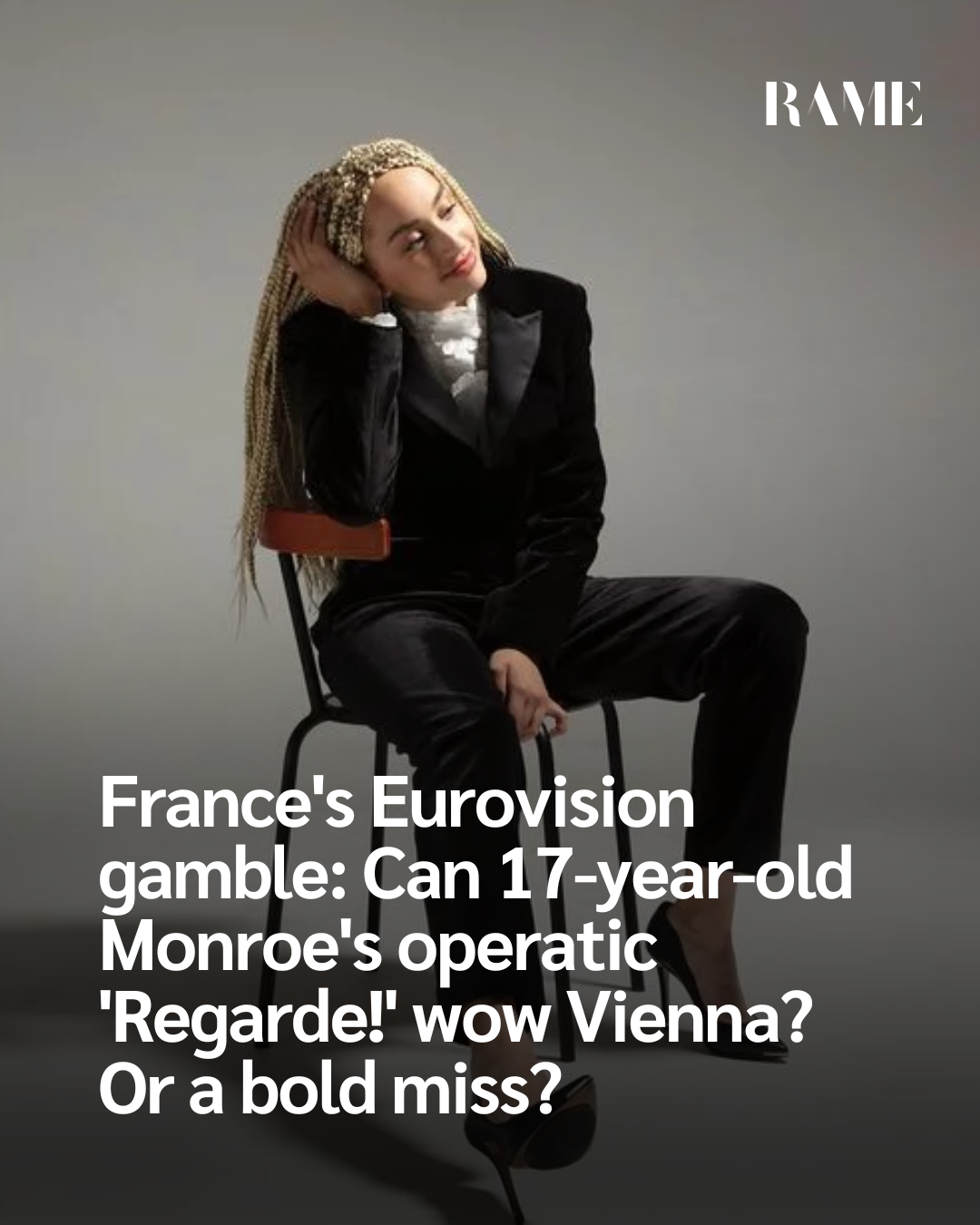
Image Credit – purepeople
France appears poised to take a bold, generational gamble at the Eurovision Song Contest 2026. Instead of leaning on established names, the country is reportedly turning to a 17-year-old soprano whose career is only just beginning but already turning heads across the classical music world.
If confirmed, Monroe’s selection would signal not just a new representative, but a shift in France’s Eurovision strategy.
A Quiet Selection Strategy Continues
French broadcaster France Télévisions has once again chosen to internally select both its artist and song, continuing a strategy adopted in 2023. This marks a clear departure from the televised national finals held between 2018 and 2022, where public participation played a key role in selecting the country’s entry.
The internally chosen track, titled “Regarde!” (Look!), is yet to be revealed, maintaining an air of mystery around France’s entry as other countries begin to finalize their lineups.
This secrecy is not unusual. In recent years, several Eurovision delegations have opted for controlled rollouts to build anticipation and maintain strategic flexibility ahead of the contest.
Who Is Monroe?
Monroe Rigby, known professionally as Monroe, is not a conventional Eurovision pick. Born in Salt Lake City, Utah, to a French mother and American father, she represents a cross-cultural identity that aligns well with Eurovision’s pan-European ethos.
Her breakthrough came in 2024 when she won Prodiges, a competition dedicated to emerging classical musicians. Her performance of Queen of the Night aria one of the most technically demanding pieces in the soprano repertoire immediately set her apart.
A judge on the show described her voice as “exceptionally controlled, yet emotionally expansive,” reflecting a rare combination of technical precision and expressive depth.
From Classical Prodigy to Eurovision Stage
Following her television success, Monroe signed with Warner Classics, releasing her debut album in late 2025. The label, known for nurturing high-caliber classical artists, has previously worked with internationally acclaimed performers suggesting confidence in Monroe’s long-term potential.
Her upcoming 2026 tour across churches in France, focusing on religious and classical repertoire, reinforces her artistic identity. Yet Eurovision presents a very different stage: one that rewards accessibility, emotional connection, and visual storytelling as much as vocal ability.
This raises an interesting question: can a classically trained soprano translate her skills into a format often dominated by pop, electronic, and genre-blending performances?
A Strategic Shift for France?
According to Clément Garin, who first reported the development via his platform CGTV, Monroe’s selection may reflect a deliberate pivot.
In recent years, France has often leaned on established or mainstream artists, aiming for broad appeal. While this approach has yielded respectable results, it has not consistently translated into victory.
By contrast, selecting a young, classically trained artist introduces both risk and opportunity:
- Risk, because Eurovision audiences may not traditionally gravitate toward operatic or classical styles.
- Opportunity, because standout vocal performances especially those that break genre norms often leave a lasting impression.
Past Eurovision history supports this. Entries that blend classical and contemporary elements, such as operatic pop, have occasionally achieved strong results by offering something distinct in a crowded field.
Vienna Awaits: The Bigger Picture
The 2026 contest, set to take place in Vienna, marks the 70th edition of Eurovision a milestone year likely to feature heightened competition and innovation.
Delegations across Europe are reportedly working “feverishly,” as insiders describe, to finalize entries ahead of key March meetings. Yet France’s decision to hold back details suggests a calculated attempt to control the narrative and maximize impact closer to the event.
If Monroe is confirmed, her performance of “Regarde!” will be scrutinized not just as a song, but as a statement of intent: a declaration that France is willing to rethink its Eurovision formula.
What This Means for Eurovision
Here’s the broader takeaway. Eurovision has increasingly become a space where authenticity and distinct identity matter as much as chart-friendly appeal. Monroe embodies that shift.
Her background in classical music, her rapid rise, and her international roots position her as a compelling figure in a competition that thrives on diversity.
But success will hinge on execution. A strong vocal alone is not enough. Staging, arrangement, and emotional resonance will determine whether “Regarde!” connects with millions of viewers across Europe and beyond.
Final Thoughts
France’s reported choice of Monroe feels like a calculated gamble one that could either redefine its Eurovision trajectory or fall short in a fiercely competitive field.
Either way, it signals something important: a willingness to experiment.
And in a contest built on spectacle, risk, and reinvention, that might be exactly what France needs.