

For years, the narrative has been loud and dramatic: streaming destroyed music, artists can’t earn a living, and fans stopped paying. It makes for a good headline. It just doesn’t hold up under scrutiny.
The money hasn’t disappeared. It has moved.
In 2026, the global music business is larger than it was at its CD-era peak in raw dollars. But once you adjust for inflation and examine who controls the pipelines, a more complicated picture emerges. The real story is not about collapse. It’s about redistribution and artists, particularly those in the middle tier, are feeling the squeeze.
Let’s break down how the system actually works.
The Industry Is Bigger But Not Necessarily Healthier

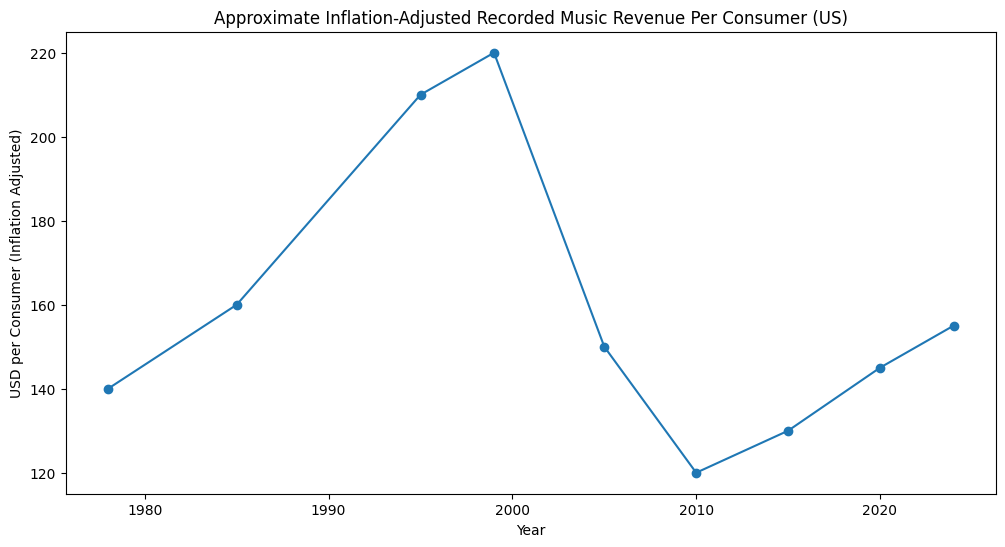
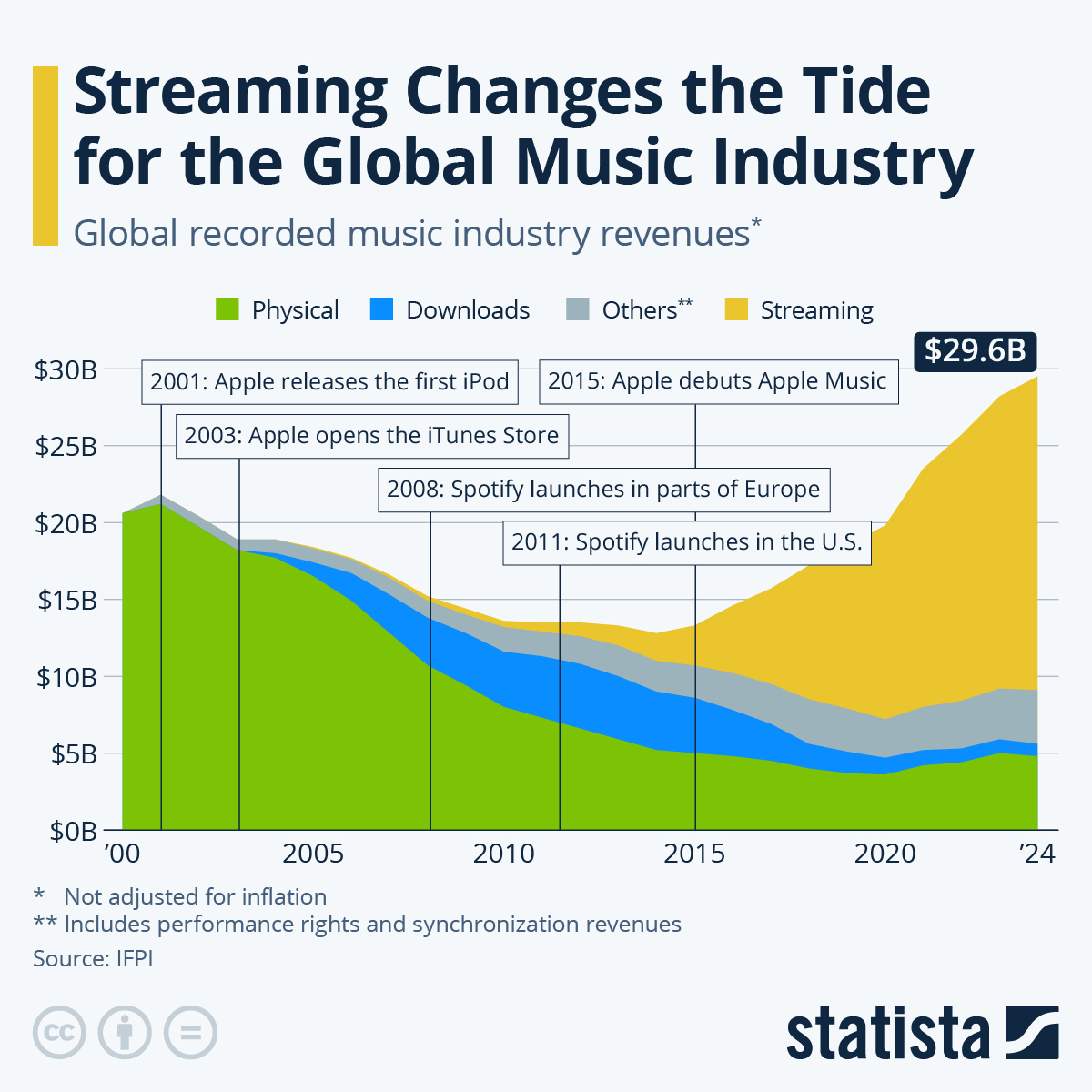
According to industry reporting from outlets such as Musically and annual data from the International Federation of the Phonographic Industry (IFPI), global recorded music revenues reached:
- 1999: ≈ $22.2 billion
- 2014: ≈ $14.0 billion
- 2023: ≈ $28.6 billion
On the surface, 2023 looks like a triumph. But inflation matters. Adjusted to 2023 dollars, the 1999 peak would be closer to $40 billion. In real terms, the industry has not fully returned to its pre-Napster era high.
The trough between 2010 and 2014, widely acknowledged across trade reporting, marked the lowest point of the post-file-sharing era. Streaming reversed the decline. But the rebound masks a structural shift: the value chain is no longer centered on selling units.
From Ownership to Access: The Subscription Revolution
For most of the 20th century, fans bought music. Whether it was vinyl, cassette, or CD, ownership drove revenue. Each format shift from LP to CD in the 1980s, for example created fresh demand and repeat purchases.
Streaming changed that logic.
Services like Spotify, Apple Music, Amazon Music and Pandora operate on access, not ownership. A fan pays one flat monthly fee for virtually unlimited listening.
This flattened consumer spending. Superfans used to buy multiple albums per year, deluxe editions, imports. Casual listeners bought far less. Now both groups pay roughly the same subscription price.
Revenue per listener has become more uniform. But revenue per artist per listener has shrunk dramatically.
That’s the critical tension in 2026.
How the Money Flows Now
The old model was relatively linear:
Consumer → Retailer → Label → Artist
In 2026, it looks more like:
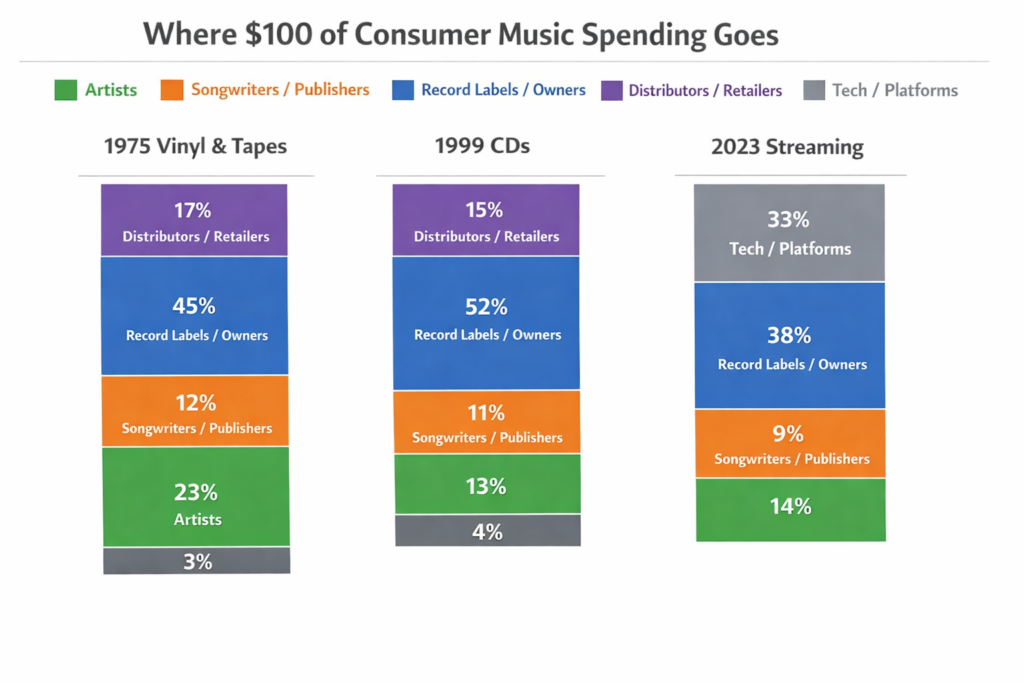
Consumer → Platform → Rights Holders → Artist
Platforms take a cut before revenue reaches labels, publishers, distributors, and eventually performers and songwriters. According to public filings from major streamers, roughly 65 to 70 percent of subscription revenue is paid out to rights holders. From there, contracts determine how much artists actually receive.
Record labels have not been passive victims. Many now operate under 360-degree agreements, participating not just in recordings but also in touring, merchandise, publishing, and brand partnerships. This diversification has strengthened major companies even as unit sales disappeared.
Meanwhile, tech platforms whose core businesses extend far beyond music sit at the top of the distribution funnel.
To executives accountable to shareholders, music is content. It competes with podcasts, audiobooks, and other forms of engagement for attention and subscription retention.
The Streaming Economics Debate
Few critics have articulated the artist perspective as clearly as David Lowery, frontman of Cracker and Camper Van Beethoven, and a senior lecturer in the Music Business Program at the University of Georgia.
Lowery has long argued that streaming compresses value:
“Streaming flattens and commoditizes the spin. So, you just have one price for every spin of a song… whether it’s some kind of avant-garde classical work or a Miley Cyrus song. That… will push out any sort of niche music.”
He has also highlighted payout realities:
“My song got played on Pandora 1 million times and all I got was $16.89, less than what I make from a single T-shirt sale.”
While exact per-stream payouts vary depending on territory, subscription tier, and contractual structure, reporting from industry analysts consistently shows that meaningful income from streaming requires scale. Millions of streams are necessary to generate what used to be achievable with far fewer unit sales.
The result is concentration. Top-tier global artists thrive. Catalog owners benefit from steady streaming consumption. Mid-tier and niche artists often struggle unless they supplement income elsewhere.
Touring, Merch, and the Return of the Road
As recorded income became less reliable, live performance became central.
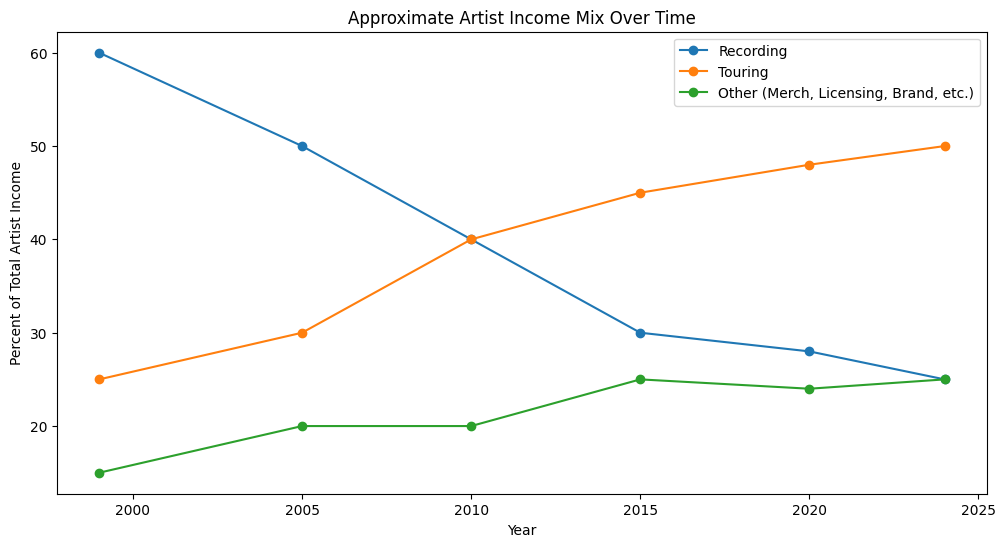
Legacy artists who might once have relied on royalties returned to the road. Touring now accounts for a significantly larger share of artist earnings than it did in the CD era. Merchandise, VIP experiences, and brand partnerships fill gaps that record sales once covered.
High-profile acts can leverage global brands and sponsorships. Mid-level artists often rely on relentless touring schedules to sustain careers.
This shift carries risks. Touring is physically demanding, capital-intensive, and vulnerable to macroeconomic shocks, as the pandemic demonstrated. It is also not equally accessible to every genre or demographic.
Winners, Losers, and the Shrinking Middle
In simplified terms, the streaming era has produced:
Winners
- Platforms
- Major catalog owners
- The top 1 percent of artists with global scale
Pressured
- Mid-tier artists without massive streaming numbers
- Niche and experimental musicians
Declining Segments
- Physical retail distribution
- Artists dependent solely on unit sales
This does not mean there is “no money in music.” Global revenues suggest otherwise. But the middle class of music once sustained by steady album sales faces structural headwinds.
A.I. and the Next Redistribution
Artificial intelligence complicates the picture further. Generative systems capable of producing music are evolving rapidly. Rights debates are ongoing in courts and legislatures worldwide, including discussions within industry bodies such as IFPI.
The central question is economic: if A.I. systems are trained on human-created works, how are original creators compensated? And at what rate?
Some analysts argue A.I. may create new service categories training models, licensing data, hybrid human-machine production. Others warn it could further compress songwriting and scoring markets, particularly in advertising and media licensing.
Given the speed of change, certainty is suspect. What seems clear is that A.I. will not eliminate the need for music. It may, however, alter who captures its value.
So, Are Fans Happier?
One overlooked dimension is consumer welfare. For roughly the price of a single CD in 1999, listeners now access tens of millions of songs instantly across devices. Discovery tools, algorithmic playlists, and global distribution have lowered barriers for both fans and creators.
From a consumer perspective, the value proposition is extraordinary.
From an artist perspective, the trade-off is stark: more reach, but less predictable income per listener.
The Real Question Facing 2026
The panic narrative misses the point. The music industry did not vanish. It reorganized.
Money still flows. It simply flows through different channels, with new gatekeepers and new power centers.
The unresolved issue is not whether streaming works. It clearly does at scale. The deeper question is whether the system can sustain a diverse creative ecosystem one that supports not just superstars, but the working musicians who form the backbone of culture.
If the middle disappears, the long-term cost may not show up immediately on balance sheets. It will show up in the range of voices we hear.
And that is something no quarterly revenue report can measure.