

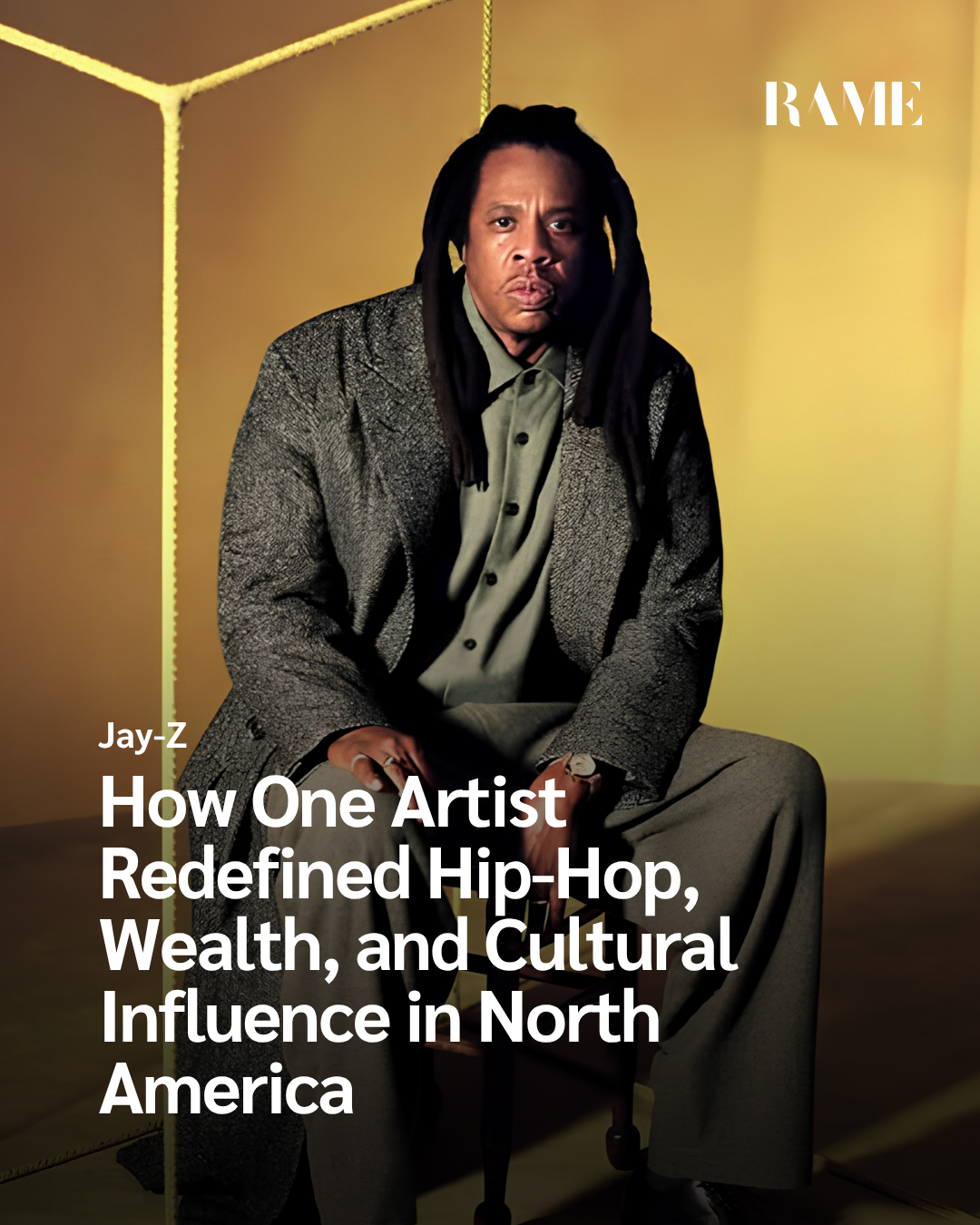
Image Credit: GQ
From Marcy Projects to Global Boardrooms
What does it really take to turn a street-level hustle into a multi-billion-dollar cultural force?
Jay-Z, born Shawn Corey Carter, offers one of the clearest answers in modern music history. Rising from Brooklyn’s Marcy Projects, he didn’t just survive the system around him, he learned how to rewrite it. Today, his influence stretches far beyond hip-hop. It sits inside streaming algorithms, luxury branding, sports ownership, and even how young entrepreneurs think about ownership itself.
For many listeners aged 18–29 across North America, Jay-Z isn’t just part of the playlist. He’s part of the playbook.
The Brooklyn Blueprint: How It All Started
Jay-Z’s early story is rooted in survival economics. Before fame, he was moving CDs independently, building demand outside traditional label structures. That mindset would later define his entire career.
His 1996 debut Reasonable Doubt marked a turning point in hip-hop storytelling. It wasn’t just street narrative, it was strategy, ambition, and introspection layered over soulful production.
Tracks like Dead Presidents II reflected a generation trying to translate struggle into mobility. As hip-hop scholar Michael Eric Dyson has often emphasized in broader cultural commentary, hip-hop became “a language of survival and aspiration” for urban America and Jay-Z became one of its most fluent speakers.
The Blueprint Era: When Hip-Hop Became Architecture
If Reasonable Doubt was foundation, The Blueprint (2001) was construction.
This album didn’t just dominate charts, it reshaped sound design in mainstream rap. Its soul-heavy sampling influenced a generation, including producers and artists like Kanye West and others who would define 2000s hip-hop.
A defining line from Jay-Z still captures his philosophy:
“I’m not a businessman, I’m a business, man.”
That single phrase became a cultural shorthand for creative ownership, widely referenced in entrepreneurship circles far outside music.
Songs like Izzo (H.O.V.A.) and Heart of the City (Ain’t No Love) still circulate heavily on streaming platforms, especially in workout, commute, and nostalgia-driven playlists.
From Roc-A-Fella to Roc Nation: Building the Infrastructure
In 1995, Jay-Z co-founded Roc-A-Fella Records, a move that fundamentally shifted how artists viewed control. Instead of waiting for industry validation, he built an independent pipeline.
Later, Roc Nation expanded that vision into management, sports, and entertainment, working across music, athlete representation, and branding.
Key expansion moves included:
- Roc Nation Sports entering athlete management
- Strategic partnerships in luxury branding
- Development of a full-service entertainment ecosystem
This evolution positioned Jay-Z less as a rapper and more as a cultural CEO.
Business Beyond Music: Luxury, Alcohol, and Tech Capital
Jay-Z’s portfolio is often discussed as much as his discography.
His ventures include:
- Armand de Brignac (Ace of Spades)
- D’Ussé cognac partnership
- Tidal (artist-centric streaming platform)
- Investments in companies like Uber and Block
The strategy here isn’t random diversification. It reflects a consistent theme: ownership in industries that shape attention and lifestyle.
In an era where Gen Z and millennials juggle side hustles and digital entrepreneurship, Jay-Z’s model feels less like celebrity wealth and more like a case study in vertical integration.
Cultural Currency: Music That Still Moves North America
Jay-Z’s catalog continues to perform strongly on streaming platforms, but its real power is cultural longevity.
Standout tracks still dominating playlists:
- Empire State of Mind (feat. Alicia Keys)
- 99 Problems
- Run This Town (feat. Rihanna, Kanye West)
- No Church in the Wild (with Kanye West and The-Dream)
These tracks operate like cultural timestamps. They show up at protests, sporting events, weddings, and gym playlists each context giving them new meaning.
As music journalist commentary often notes, Jay-Z’s work survives not because it trends, but because it adapts.
Influence Loop: How Jay-Z Shaped the Next Generation
Jay-Z’s impact can be traced directly through modern artists and platforms.
- Drake’s introspective luxury storytelling
- TikTok edits reviving classic verses
- SoundCloud-era independence models
- Fashion crossover with streetwear giants like Supreme and Off-White
- Fear of God–style luxury street aesthetics
His influence is not just musical, it’s structural.
Even the way artists negotiate ownership today reflects lessons pioneered in the Roc-A-Fella era.
Culture, Activism, and Accountability
Beyond business and music, Jay-Z has positioned himself in social discourse through initiatives like the Shawn Carter Foundation and Roc Nation-led social justice work.
He has supported criminal justice reform efforts in the United States, especially around incarceration disparities affecting Black communities.
His 2017 album 4:44 marked a tonal shift, more reflective, personal, and openly accountable. In hip-hop culture, where image often dominates introspection, that pivot mattered.
Legacy Question: What Does the Blueprint Mean Now?
Jay-Z’s legacy isn’t frozen in nostalgia. It’s actively shaping how young people think about control, ownership, and ambition.
But there’s a tension worth noting.
Can one model of success, built in a specific cultural and economic moment still apply cleanly to today’s creator economy?
The answer may not be simple. Streaming platforms, algorithmic discovery, and fast-moving digital trends have changed the rules. Yet Jay-Z’s core lesson still holds: ownership compounds power.
Conclusion: The Blueprint Isn’t an Ending, It’s a Framework
Jay-Z’s story is often told as a rise from poverty to billionaire status. That framing misses something bigger.
His real legacy is structural. He showed that artists don’t just have to participate in systems, they can build them.
And in 2026, as young creators across North America try to turn content into careers, the question his journey raises is still open:
Are you just part of the culture, or are you building the infrastructure behind it?